







One of the most common challenges we hear from B2B merchants isn’t about taking orders - it’s about everything that happens after the order is placed.
Invoices get created manually. Payment status lives inside an accounting tool. Sales teams are checking multiple systems just to answer a simple question: “Has this been paid yet?”
Today, we’re excited to introduce SparkLayer Accounting Integrations - a native way to connect your B2B storefront with Xero, QuickBooks Online, and Shopify.
The goal is simple: bring orders, invoices, and payments together into a single, clearer workflow.
Less manual finance work, more visibility where it matters
For many wholesale businesses, finance workflows rely on exports, spreadsheets, or third-party automation tools just to keep systems aligned.
That might work at smaller volumes, but it quickly becomes a bottleneck as your B2B business grows.
With SparkLayer’s new accounting integrations:
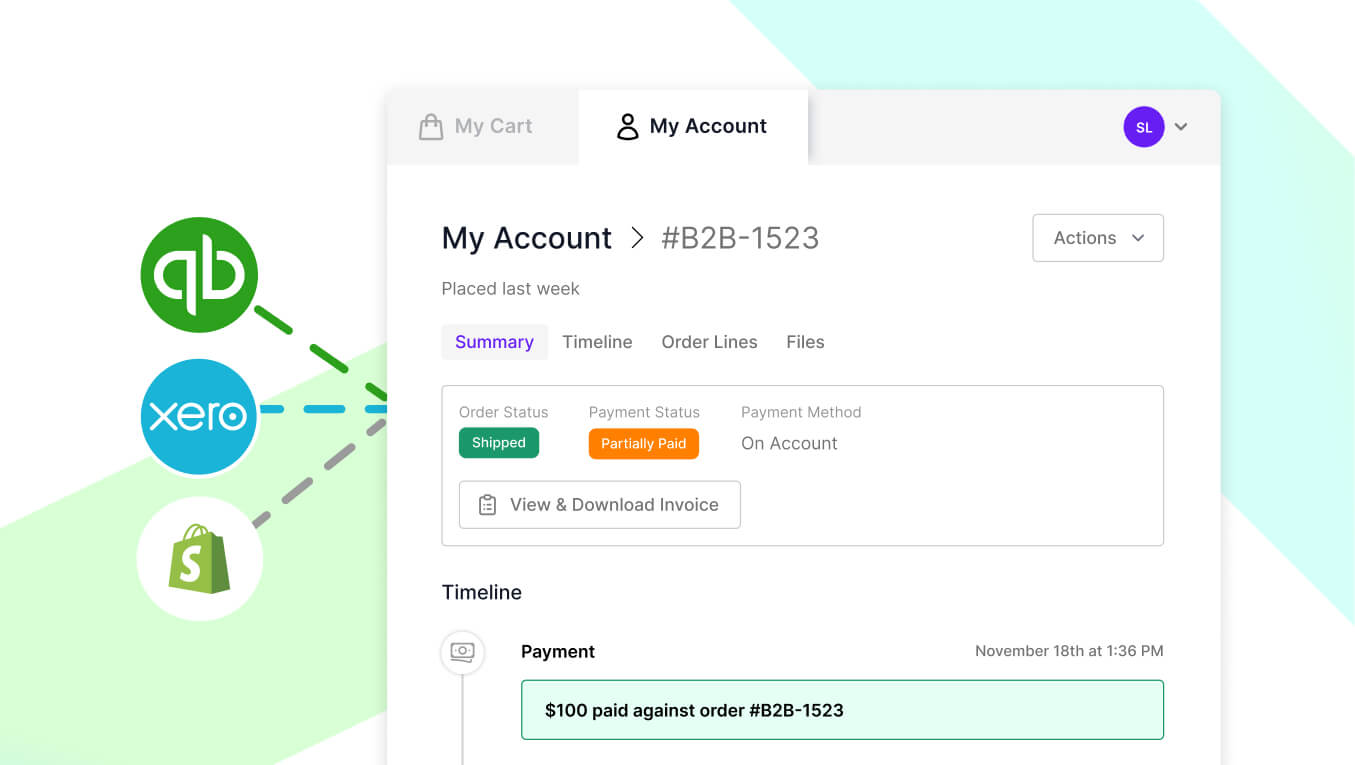
- Orders can automatically create invoices in Xero or QuickBooks Online
- Payment status and balances sync back into SparkLayer
- Customers can see invoices and outstanding balances directly in their account
Instead of jumping between platforms, your team gets the context they need exactly where they’re already working.
Payment visibility built into the B2B experience
One thing we’ve learned building SparkLayer is that B2B buyers expect clarity - especially when it comes to invoices and payments.
So alongside automated invoicing, we’ve introduced improved payment visibility across SparkLayer.
Customers can now:
- View invoices directly in their account
- See payment status (paid, unpaid, partially paid)
- Check outstanding balances without contacting your team
For merchants, this reduces friction. For customers, it removes uncertainty. And for your operations team, it means fewer payment-related queries to manage.
Native integrations, not another workaround
A lot of B2B merchants already use Xero or QuickBooks Online - but until now, connecting those systems to their storefront often meant relying on external automation tools or custom integrations.
We wanted to take a different approach.
SparkLayer’s accounting integrations are built natively into the platform, meaning:
- No extra tools to maintain
- Fewer sync issues
- A simpler setup experience
- A more consistent data flow between ordering and accounting
Your accounting platform stays the source of truth, while SparkLayer brings that data into your B2B workflows where it’s actually useful.
What’s included
Here’s a quick overview of what you can expect from SparkLayer Accounting Integrations:
- Automatic invoice creation from B2B orders
- Native integration with Xero and QuickBooks Online
- Payment status and balance syncing back into SparkLayer
- Invoice downloads and visibility for customers
- Optional automatic contact creation
- Control over when invoices are triggered
Everything is designed to fit naturally into your existing SparkLayer setup - not add another layer of complexity.
Why we built this
As SparkLayer grows, we’re continuing to focus on removing friction across the entire B2B journey - not just the storefront.
Wholesale ordering doesn’t exist in isolation. It connects directly to finance, operations, and customer relationships.
By bringing accounting visibility into SparkLayer, we’re helping teams work faster, reduce manual admin, and give customers a more professional, transparent experience.
Available now
SparkLayer Accounting Integrations are available today for merchants using Shopify, Wix, BigCommerce, and other supported platforms.
Existing customers can enable the integration from their dashboard, and new users can explore it as part of a 14-day free trial.
👉 Learn more about our Accounting Integrations 👉 Or dive deeper into our Help Docs