







Quick summary
Not every B2B eCommerce platform is built for wholesale. The best options give trade buyers self-serve ordering, account-specific pricing, and a checkout built for bulk orders without requiring your team to manage everything manually. For more on scaling wholesale, explore our Best Practice guides.
Here are our top three picks:
| # | Tool | Best For |
|---|---|---|
| 1 | SparkLayer | Wholesalers wanting a complete B2B portal without replatforming |
| 2 | Shopify Plus | Brands running DTC and wholesale from one admin |
| 3 | OroCommerce | Distributors with complex multi-account B2B requirements |
SparkLayer is a leading B2B eCommerce platform for wholesalers
SparkLayer is a B2B eCommerce specialist trusted by 3,500+ global brands including Specialised Welding Products, Asmodee UK, and Nature's Path. We have helped wholesalers, distributors, and manufacturers build proper B2B buying experiences on top of the stores they already run.
We know firsthand where wholesale operations plateau. Buyers call instead of ordering online. Reps re-key orders from spreadsheets. Pricing lives in the ERP but gets updated manually in the store. SparkLayer solves all three without requiring a replatform, a rebuild, or a separate wholesale storefront. The frontend gives buyers a branded self-serve portal. The backend connects to your ERP, accounting system, and existing store data in real time.
How SparkLayer works
The storefront, the dashboard and the journey from install to first B2B order.
Explore How SparkLayer worksThe best B2B eCommerce platforms for wholesalers compared
Compare the leading B2B eCommerce platforms across pricing, features, ERP integrations, and time to launch.
| # | Platform | Starting Price | Native B2B Features | ERP Integration | Setup Time |
|---|---|---|---|---|---|
| 1 | SparkLayerB2B layer on existing store | Free; paid from $49/month | Self-serve portal, rep ordering, quoting, AI cart, catalogues | Xero, QuickBooks, Brightpearl, Linnworks, Cin7, Unleashed, Katana natively | Hours — most brands live within a day |
| 2 | Shopify PlusSaaS eCommerce platform | $2,300/month (3-year term) | Company accounts, catalogues, net terms, PO numbers, B2B checkout | Via Shopify App Store; no native ERP connector | 3-6 months for full B2B deployment |
| 3 | BigCommerceSaaS eCommerce platform | $29/month; B2B Edition custom | Account pricing, quotes, approvals, reordering via B2B Edition | Via app marketplace; no native ERP connector | 3-6 months for full B2B deployment |
| 4 | WooCommerceOpen-source WordPress plugin | Free to install; plugins extra | No native B2B; all features require third-party plugins | Via third-party plugins; no native ERP connector | Weeks, depending on plugin stack chosen |
| 5 | OroCommercePurpose-built B2B platform | Custom enterprise pricing | CRM, CPQ, RFQ, account hierarchies, punchout all built in | Native SAP, NetSuite, Microsoft Dynamics connectors included | 6–12 months (specialist partner required) |
1. SparkLayer
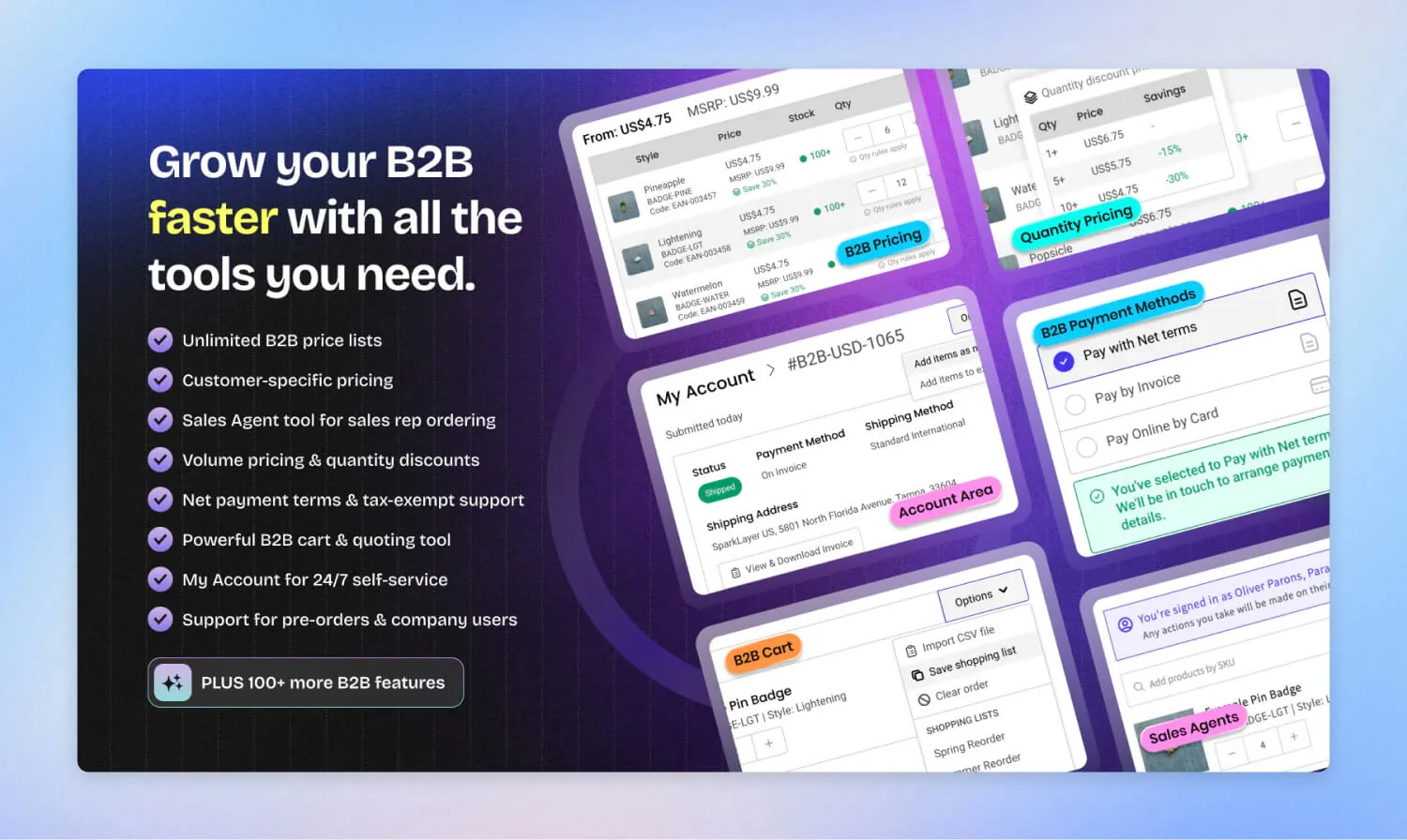
SparkLayer layers a full B2B wholesale experience on top of your existing Shopify, BigCommerce, Wix, or WooCommerce store. Trade buyers log in and see their own pricing, catalogue, and a checkout built for wholesale ordering. Your retail customers see nothing different. Both channels run from the same backend with no duplication of effort.
The Sales Agent Portal lets your reps log into the storefront as a specific trade account, pull up account-specific pricing, and complete orders on behalf of buyers in real time. The Quoting Engine handles negotiated pricing end to end, from quote request to order conversion, without a separate tool. The AI Intelligent Cart reads emailed purchase orders, spreadsheets, and PDFs and builds the cart automatically. For brands on platforms beyond the native four, SparkLayer Ignite makes the same experience possible on any website or custom platform.
✓Pros
- Live in hours with no replatforming, no developer required, no separate storefront to maintain
- Sales Agent Portal, Quoting Engine, and AI Cart included, covering every wholesale order scenario
- Free plan available, paid plans from $49/month with a 14-day free trial
- Built specifically for B2B wholesale rather than adapted from a B2C platform.
- Connects natively to Brightpearl, NetSuite, Linnworks, Cin7, Sage, Xero, and QuickBooks
✕Cons
- Works as a B2B layer, not a standalone platform, so an existing store is required
2. Shopify Plus
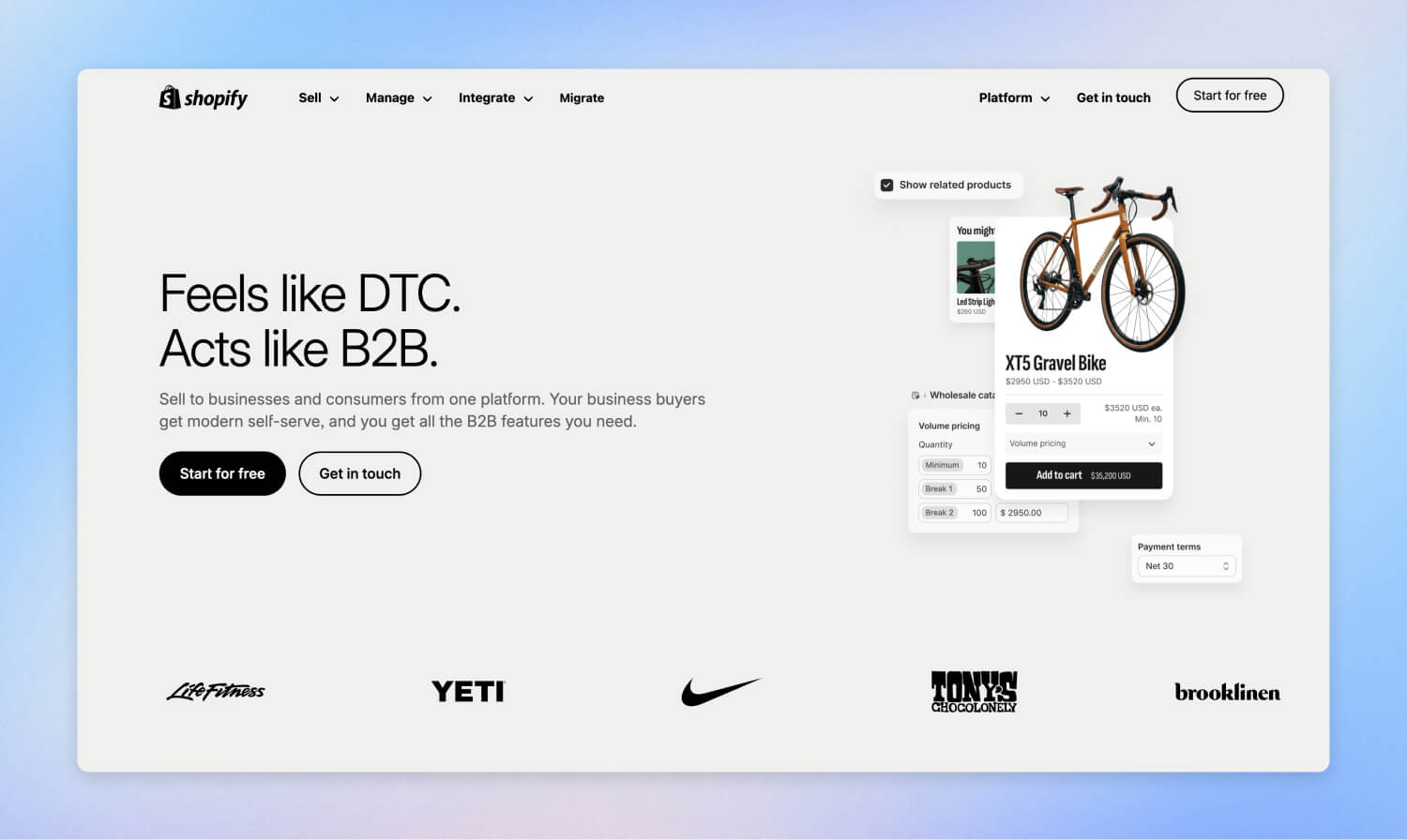
Shopify Plus is Shopify's enterprise tier, built for high-volume brands that want to manage both direct-to-consumer and wholesale from a single backend. Since 2022, Shopify has significantly expanded its native B2B features, company accounts, customer-specific pricing catalogues, net terms, PO numbers, and a dedicated B2B checkout are now available across plans, with Shopify Plus unlocking unlimited catalogues and expansion stores.
It is the fastest SaaS path to launch for brands already running Shopify who want to add wholesale without switching platforms. Implementation typically takes three to six months for a full B2B deployment. The trade-off is depth: Shopify's native B2B covers the basics well, but advanced wholesale workflows like rep-assisted ordering, quoting, and AI-powered order processing require third-party apps.
✓Pros
- Native B2B features cover company accounts, pricing, net terms, and PO numbers
- Largest app ecosystem of any platform, with strong partner and developer network
✕Cons
- Starts at $2,300/month on a three-year term, a significant jump from standard plans
- Deep B2B requirements like quoting and rep ordering need additional apps
- Three-catalogue limit on standard plans; unlimited catalogues require Plus
3. BigCommerce
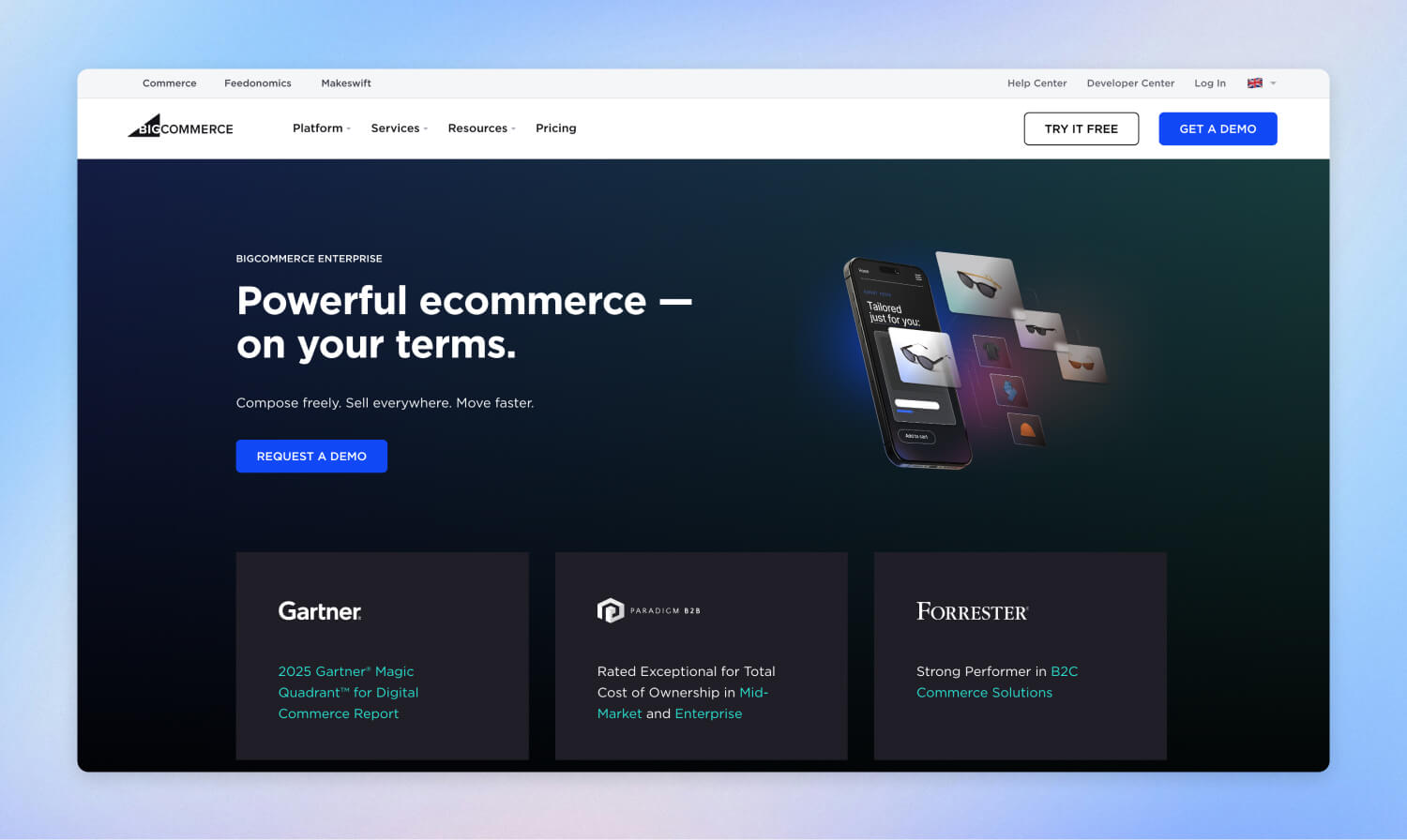
BigCommerce sits between SaaS simplicity and composable flexibility. Its B2B Edition adds buyer-facing features on top of a mature commerce engine: account-specific pricing, quote workflows, approval chains, and self-service reordering without needing to stack third-party apps. It suits mid-market wholesalers who want B2B capability without the full enterprise overhead of Adobe Commerce or OroCommerce. Implementation typically takes three to six months for a full B2B deployment.
Zero transaction fees across all plans is a genuine differentiator for wholesalers processing high order volumes, where percentage fees compound quickly. Native headless support also means brands can build custom front ends without platform lock-in.
✓Pros
- Strong native B2B features without requiring a separate app layer
- Zero transaction fees regardless of payment gateway, significant for high-volume wholesale
- Headless-friendly for brands wanting a custom buyer experience
✕Cons
- Revenue-based plan upgrades can push brands to higher tiers before they need the extra features
- Smaller app ecosystem than Shopify, meaning some integrations require custom development
4. WooCommerce
WooCommerce is the eCommerce layer for WordPress. It is free to install and has the largest plugin ecosystem in eCommerce. For brands already running WordPress at scale, it avoids a platform migration entirely. The catch is that WooCommerce has no native B2B functionality, account-specific pricing, net terms, wholesale order forms, and tax exemptions all require third-party plugins. Managing multiple plugins at scale introduces performance and compatibility risks that grow with order volume.
For smaller wholesale operations on a tight budget that are already on WordPress, WooCommerce with the right plugin stack is a workable starting point. For brands scaling seriously, the plugin maintenance overhead tends to become a problem before the platform's limits do. If that sounds familiar, SparkLayer adds a complete B2B layer to your existing WooCommerce store without a migration or rebuild.
✓Pros
- Free to install with no platform licence cost
- Largest plugin ecosystem in eCommerce, covering almost any wholesale use case
- No migration required for brands already running WordPress
✕Cons
- No native B2B functionality, every wholesale feature requires a plugin
- Plugin conflicts at scale cause unexpected issues requiring developer time to diagnose
- Security, hosting, and performance management falls entirely on the merchant
5. OroCommerce
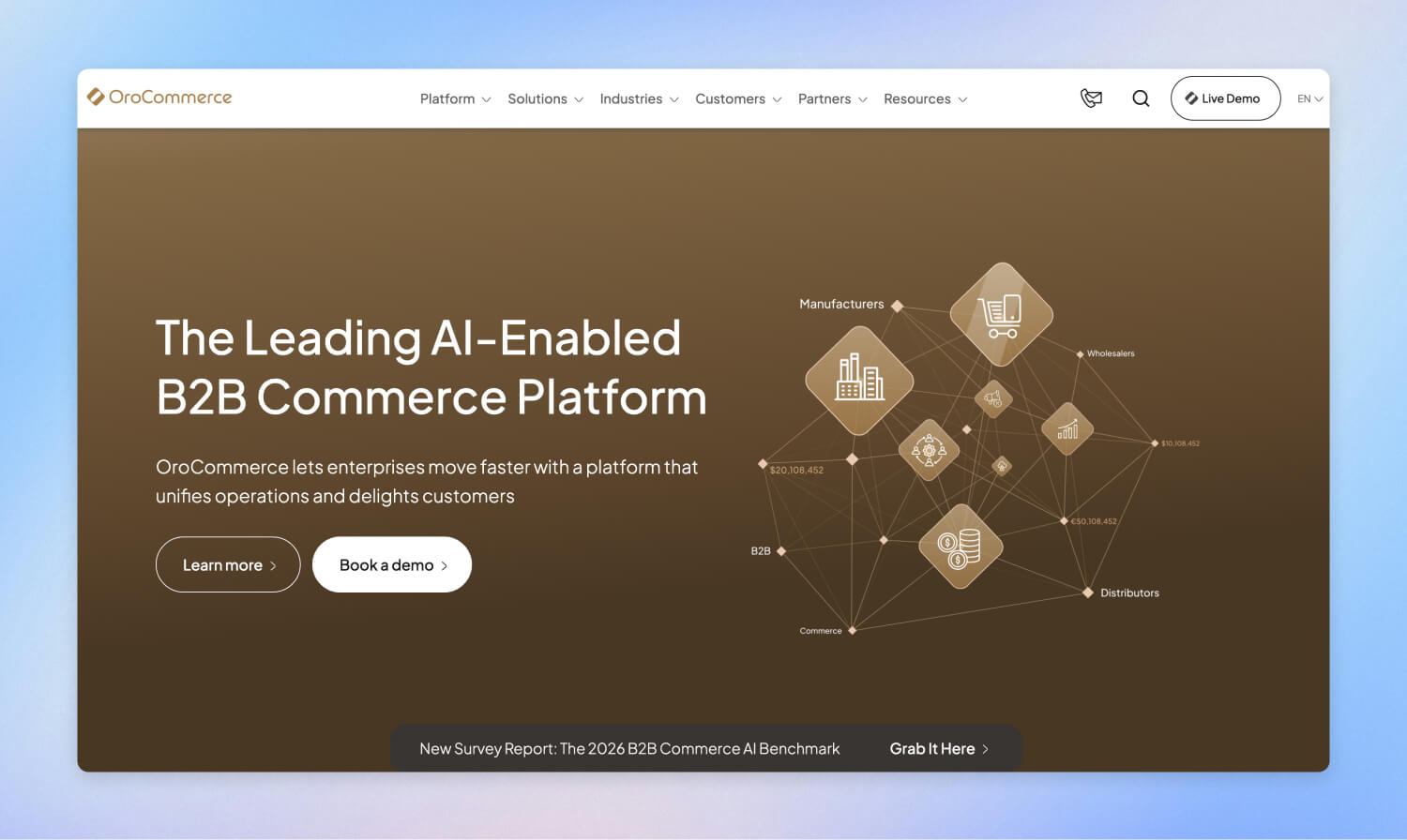
OroCommerce is purpose-built for B2B and nothing else. It ships with CRM, CPQ, quoting, and ERP connectors under a single licence, designed for manufacturers and distributors with genuinely complex operations: multi-tier account hierarchies, RFQ workflows, approval chains, punchout catalogue integration, and deep ERP dependencies. It is the strongest option on this list for enterprise B2B complexity.
The trade-off is implementation time and specialist resources. OroCommerce typically takes six to twelve months to go live and requires a specialist implementation partner. It is the right call for enterprises that need maximum B2B depth and have the technical resource to support it.
✓Pros
- Purpose-built for B2B with CRM, CPQ, and ERP connectors included under one licence
- Handles complex account hierarchies, approval chains, and RFQ workflows natively
- No per-site fees, making it cost-effective for large multi-brand enterprises
✕Cons
- Implementation typically takes six to twelve months and requires specialist partner resource
- Less suitable for brands wanting a fast launch or a simpler wholesale setup
Ready to add B2B wholesale to your existing store?
Most wholesalers do not need to replatform to get a proper B2B buying experience. SparkLayer adds self-serve ordering, rep tools, quoting, and ERP integration on top of the store you already run. There is no rebuild, no separate storefront, and no developer needed. Most brands go live within a day, and most teams adapt instantly.
Start free, or book a demo to see SparkLayer running on your store.