







Quick summary
OroCommerce is purpose-built for B2B, but it comes with enterprise complexity, long implementation timelines, and a total cost of ownership that many mid-market brands cannot justify. This guide covers the best OroCommerce alternatives for wholesalers, distributors, and manufacturers who need genuine B2B depth without a six to twelve month build. For more on scaling wholesale, explore our Best Practice guides.
Here are our top three picks:
| # | Tool | Best For |
|---|---|---|
| 1 | SparkLayer | Wholesalers wanting full B2B depth without replatforming or lengthy implementation |
| 2 | Adobe Commerce | Manufacturers needing deep customisation and complex catalogue management |
| 3 | BigCommerce B2B Edition | Distributors wanting strong native B2B features on a proven SaaS platform |
SparkLayer is a leading B2B eCommerce platform trusted by thousands
SparkLayer is a B2B eCommerce specialist trusted by 3,500+ global brands including Schneider Electric, Specialised Welding Products, and Asmodee UK. We have helped manufacturers, distributors, and wholesalers build proper B2B buying experiences without the implementation projects, specialist developer requirements, and enterprise licensing costs that come with platforms like OroCommerce.
OroCommerce is built for organizations with highly complex, multi-entity operations and the technical resources to support them. For many wholesale businesses, however, a faster, easier-to-manage platform is the better fit. SparkLayer delivers enterprise-grade B2B capabilities on top of your existing ecommerce store, helping teams launch quickly while keeping pricing, inventory, and customer data in sync. See the full list of SparkLayer integrations.
OroCommerce alternatives compared
The table below highlights the leading OroCommerce alternatives for pricing, implementation, and built-in B2B capabilities.
| # | Platform | Implementation Time | B2B Native Features | Starting Price |
|---|---|---|---|---|
| 1 | SparkLayerB2B layer on existing store | Hours. (typically live within a day) | Self-serve portal, rep ordering, quoting, AI cart, ERP sync | Free; paid from $49/month |
| 2 | Adobe CommerceEnterprise eCommerce platform | 6-12 months for B2B implementation | Company accounts, shared catalogues, RFQ, credit limits, PO support | Quote-based |
| 3 | BigCommerce B2B EditionSaaS eCommerce platform | 3-6 months | Account pricing, quotes, approvals, reordering, invoice management | Custom; from ~$1,000/month |
| 4 | Shopify PlusSaaS eCommerce platform | Typically weeks to several months, depending on implementation complexity | Company accounts, catalogues, net terms, PO numbers, B2B checkout | $2,300/month (3-year term) |
| 5 | commercetoolsComposable commerce platform | 6-12 months traditionally; 2-3 months with accelerators | Account hierarchies, pricing, quotes, approvals via API modules | Custom enterprise pricing |
1. SparkLayer
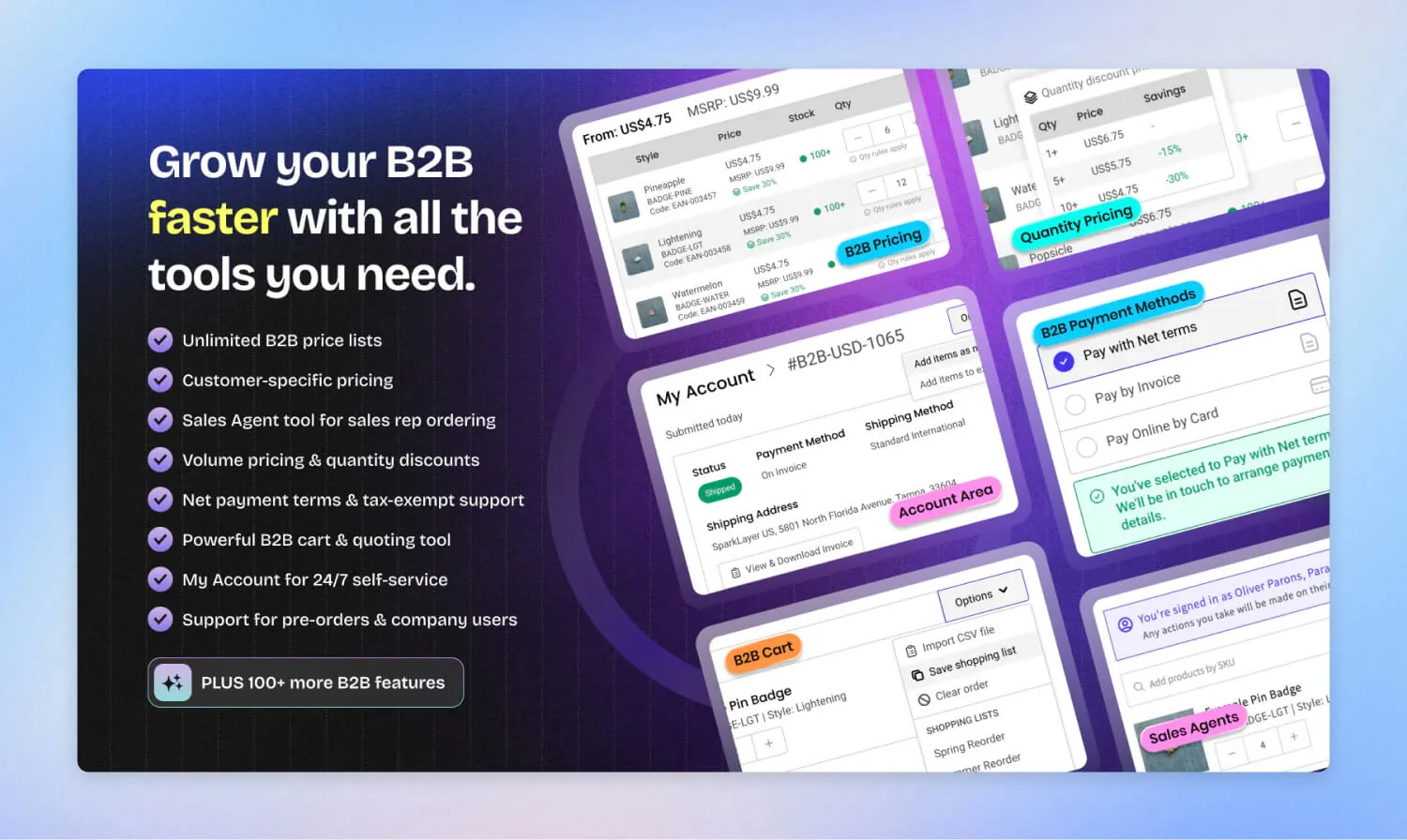
Trade buyers log into a branded wholesale portal with their own pricing, catalogue, and a checkout built for bulk ordering. Your retail store stays exactly as it is, while both B2B and DTC operations run from the same backend without duplicated workflows or pricing conflicts.
SparkLayer includes purpose-built tools for every stage of the wholesale buying journey. The Sales Agent Portal lets reps place orders on behalf of customers using live account-specific pricing. The Quoting Engine manages the full RFQ process from request to order conversion. The AI Intelligent Cart turns emailed purchase orders, spreadsheets, and PDFs into ready-to-review carts, removing the need for manual order re-keying. For businesses on custom platforms, SparkLayer Ignite extends the same B2B experience beyond Shopify, BigCommerce, WooCommerce, and Wix.
Rather than replacing your existing commerce stack, SparkLayer enhances it with a complete B2B wholesale layer. Most brands are live within a day, giving wholesalers the functionality they need without the lengthy implementation projects or ongoing development overhead associated with traditional B2B platforms.
✓Pros
- Purpose-built for B2B wholesale, covering self-serve ordering, rep tools, quoting, and ERP integration
- Combines every core B2B capability in one platform instead of multiple apps.
- Works on top of your existing store without requiring a platform rebuild or replatforming project
- Live within a day with no developer required and no specialist implementation partner needed
- Strong wholesale automation through the Quoting Engine, Sales Agent Portal, and AI Intelligent Cart
✕Cons
- Best suited for businesses with established B2B or wholesale operations
2. Adobe Commerce
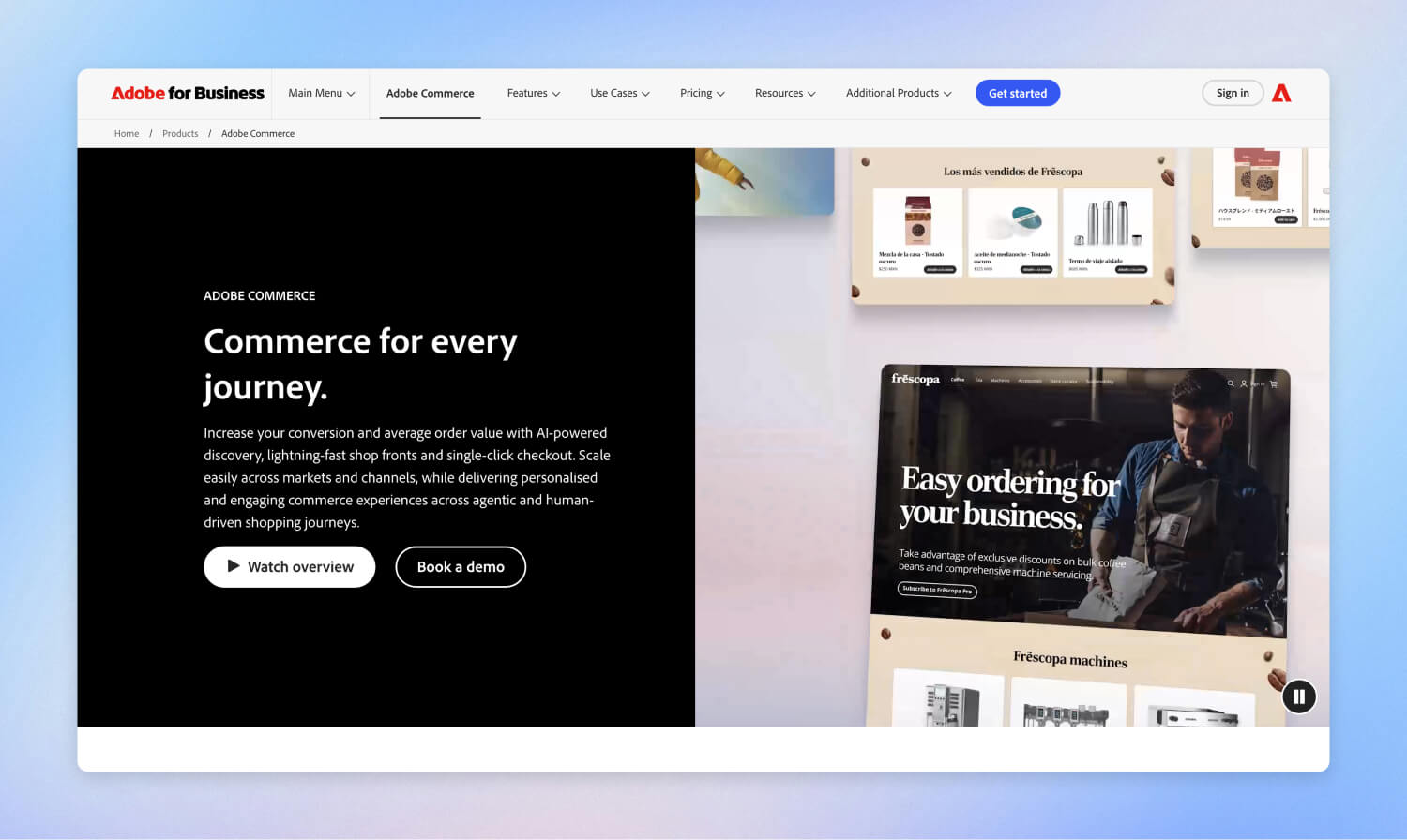
Adobe Commerce (formerly Magento) is the most customisable platform on this list. It gives development teams code-level control over every aspect of the commerce experience, from data models and customer groups to checkout logic and merchandising rules. For manufacturers with genuinely complex catalogue structures, multi-store architectures, and deep integration requirements, Adobe Commerce provides more flexibility than any SaaS platform can match.
It includes native B2B features out of the box, company accounts, shared catalogues, requisition lists, purchase orders, credit limits, and RFQ workflows, covering most of what OroCommerce offers on the B2B side. The trade-off is implementation complexity and cost. Adobe Commerce typically requires a dedicated agency or development team to implement and maintain, with total annual costs often running two to three times the licence fee.
✓Pros
- Deepest customisation of any platform on this list, with full code-level control
- Strong native B2B feature set covering catalogues, RFQ, purchase orders, and credit limits
- Adobe Experience Cloud integration for brands that need commerce connected to content and analytics
✕Cons
- Implementation typically takes six to twelve months and requires a dedicated development team
- High total cost of ownership once agency fees, hosting, and ongoing maintenance are factored in
3. BigCommerce B2B Edition
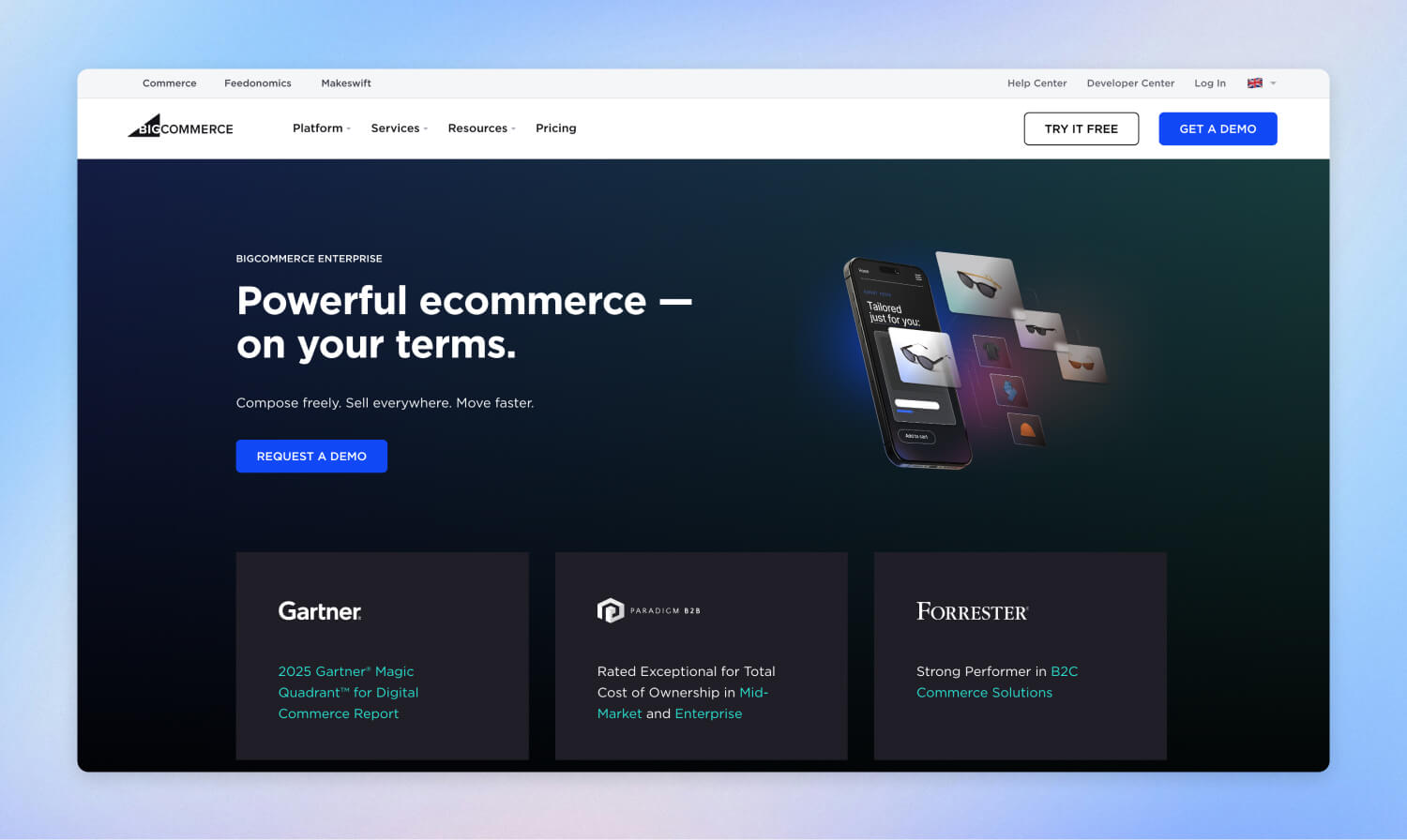
BigCommerce B2B Edition adds a purpose-built wholesale layer on top of BigCommerce's mature SaaS commerce engine. It covers account-specific pricing, quote workflows, approval chains, invoice management, and self-service reordering without needing to stack third-party apps. For distributors moving away from OroCommerce's complexity, BigCommerce B2B Edition offers similar B2B depth at a lower total cost of ownership and faster implementation timeline.
Zero transaction fees across all plans is a genuine advantage for high-volume distributors where percentage fees compound quickly. Native headless support means brands can build custom buyer experiences without platform lock-in. The limitation is that some more complex OroCommerce workflows, deep multi-entity account structures and advanced CPQ, are harder to replicate on BigCommerce without customisation.
✓Pros
- Strong native B2B features without requiring a separate app layer or significant development work
- Zero transaction fees regardless of payment gateway, significant for high-volume wholesale
- Faster implementation than OroCommerce with a lower total cost of ownership
✕Cons
- Revenue-based plan upgrades can push brands to higher tiers before they need the extra features
- Deep multi-entity account structures require more customisation than OroCommerce handles natively
4. Shopify Plus
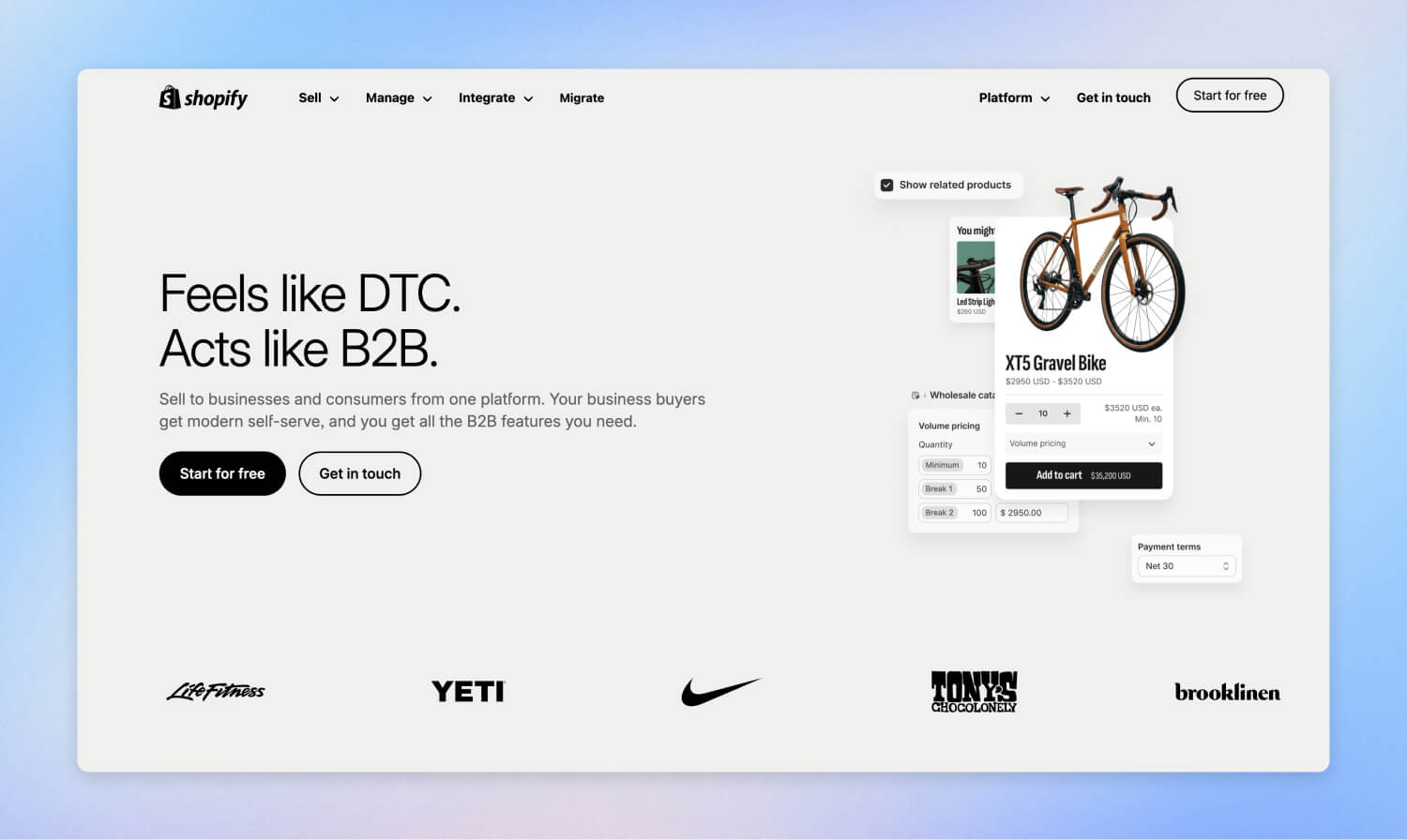
Shopify Plus is the natural alternative for brands that need to add wholesale to an existing DTC operation rather than build a standalone B2B platform. Since 2022, Shopify has significantly expanded its native B2B features, company accounts, customer-specific pricing catalogues, net terms, PO numbers, and a dedicated B2B checkout are now available, with Shopify Plus unlocking unlimited catalogues and expansion stores.
For brands already running Shopify, Plus is the fastest path to adding B2B without a platform migration. For brands evaluating OroCommerce because their current platform lacks B2B depth, Shopify Plus combined with SparkLayer covers most of what OroCommerce offers at a fraction of the implementation time and cost. SparkLayer installs as an app, works within the existing Shopify Plus environment, and is live within a day with no additional implementation project required.
✓Pros
- Fastest path to launching B2B for brands already on Shopify
- Largest app ecosystem of any platform, with strong partner and developer network
- Runs B2B and DTC from one admin, one product catalogue, and one backend
✕Cons
- Advanced B2B workflows like quoting and rep ordering require third-party apps
- Three-catalogue limit on standard plans; unlimited catalogues require Plus
5. commercetools
commercetools is MACH architecture applied to commerce. Every capability from pricing, catalogue, cart, checkout, orders, is a separate microservice behind an API. There is no built-in frontend. Engineering teams build everything. For enterprises that want maximum architectural flexibility and are treating commerce as a fully owned software product, commercetools offers more future-proofing than any other platform on this list.
It is the most demanding option to operate. commercetools is not a platform you configure; it is a platform you build. Implementation typically takes twelve months or more and requires skilled architects and developers throughout. For brands moving away from OroCommerce because it felt too complex, commercetools is likely a step up in complexity rather than a step down. If that describes your situation, SparkLayer is worth evaluating first.
✓Pros
- Maximum architectural flexibility with no vendor lock-in at any layer
- Strongest API granularity of any platform, with 300+ REST and GraphQL endpoints
- Cloud-native scaling without infrastructure management overhead
✕Cons
- No frontend out of the box; every buyer-facing experience must be built from scratch
- Implementation complexity makes it unsuitable for brands wanting a faster, simpler path forward
Ready to move beyond OroCommerce without a six-month build?
SparkLayer gives manufacturers, distributors, and wholesalers the B2B capabilities they need, including rep ordering, quoting, AI-powered order capture, ERP integration, and a branded buyer portal, without the lengthy implementation projects, specialist developers, or enterprise licensing costs associated with OroCommerce. Most brands go live within a day.
Start free, or book a demo to see SparkLayer running on your store.